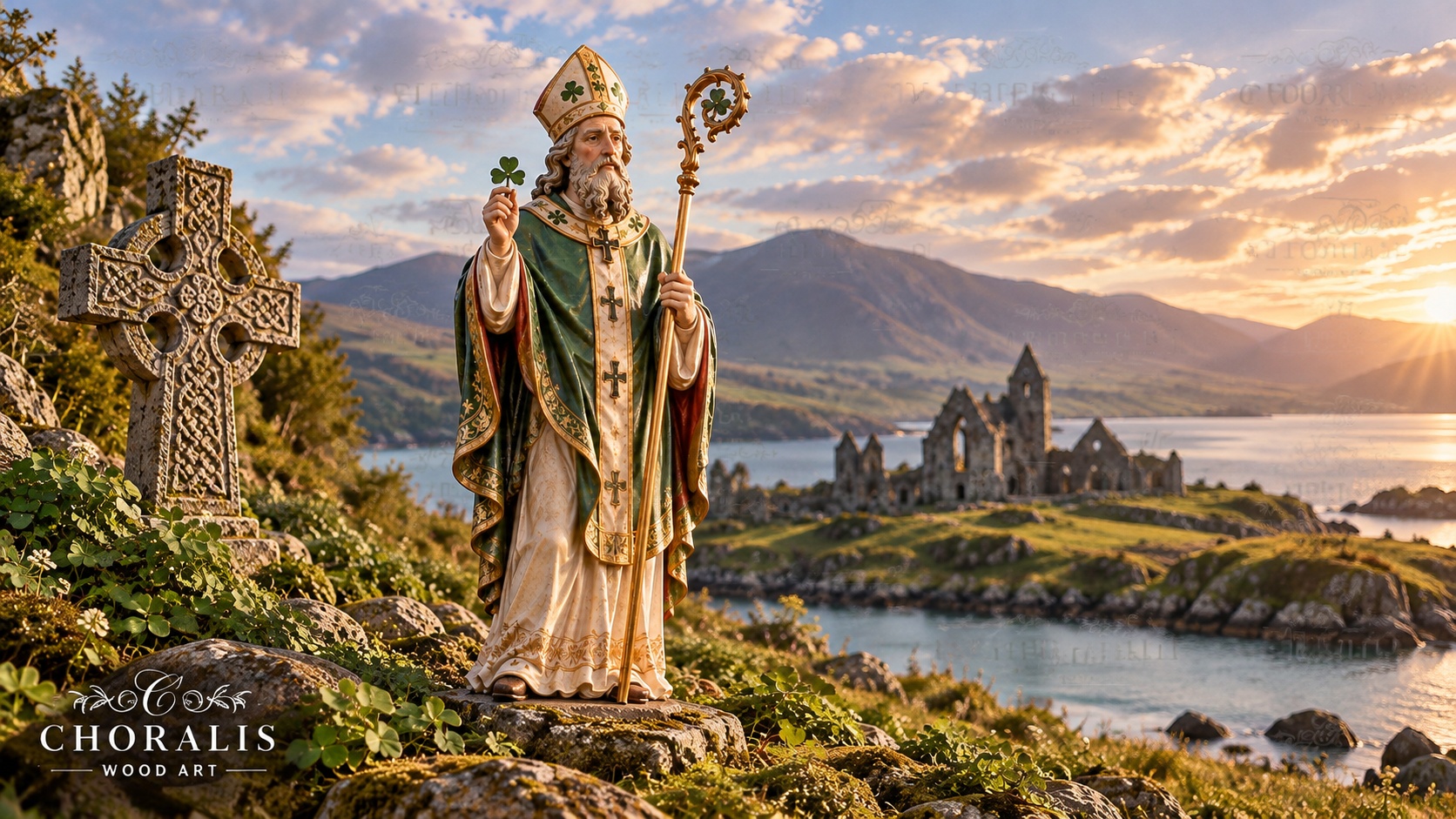
Saint Patrick, Bishop: Apostle of Ireland and Witness of Faith
Saint Patrick is one of the best-known Christian saints and the principal patron saint of Ireland. His life is associated with the spread of Christianity in Ireland, missionary courage, perseverance, and deep trust in God.
 Although many legends arose around Saint Patrick over the centuries, the most important source for his life is Patrick himself, especially his Confessio. His story is remarkable: as a young man he was taken to Ireland as a slave, but years later he returned there voluntarily as a missionary and bishop.
His feast day is celebrated on 17 March. Today, Saint Patrick is venerated not only in Ireland, but throughout the world.
The Life of Saint Patrick
Patrick was born in Roman Britain, probably toward the end of the fourth century. He came from a Christian family; his father was a deacon and his grandfather was a priest. Patrick later admitted, however, that in his youth his faith was not yet deeply rooted.
When he was about sixteen years old, he was captured by Irish raiders and taken to Ireland, where he spent several years in slavery. He worked as a shepherd and lived in difficult conditions, far from his family and homeland.
It was during this period that his relationship with God changed profoundly. In solitude and hardship, Patrick began to pray intensely. He later described how his faith grew and how prayer became a natural part of his daily life.
After approximately six years, Patrick escaped from captivity and eventually returned to his family. Yet his experience in Ireland did not disappear from his heart. He later understood that he was being called to return to the people among whom he had once lived as a slave.
Patrick prepared for ecclesiastical service and eventually returned to Ireland as a missionary and bishop. His mission was not easy. He preached the Gospel, baptized new Christians, supported the establishment of Christian communities, and worked in an environment shaped by local customs and pre-Christian beliefs.
Patrick did not present himself as a powerful conqueror. In his own writings, he repeatedly emphasized his weakness, his limitations, and his dependence on God's grace. This humility is one of the strongest features of his spiritual legacy.
The exact date and circumstances of his death are uncertain, but tradition connects his death with 17 March, the day on which his liturgical feast is celebrated.
Iconography of Saint Patrick
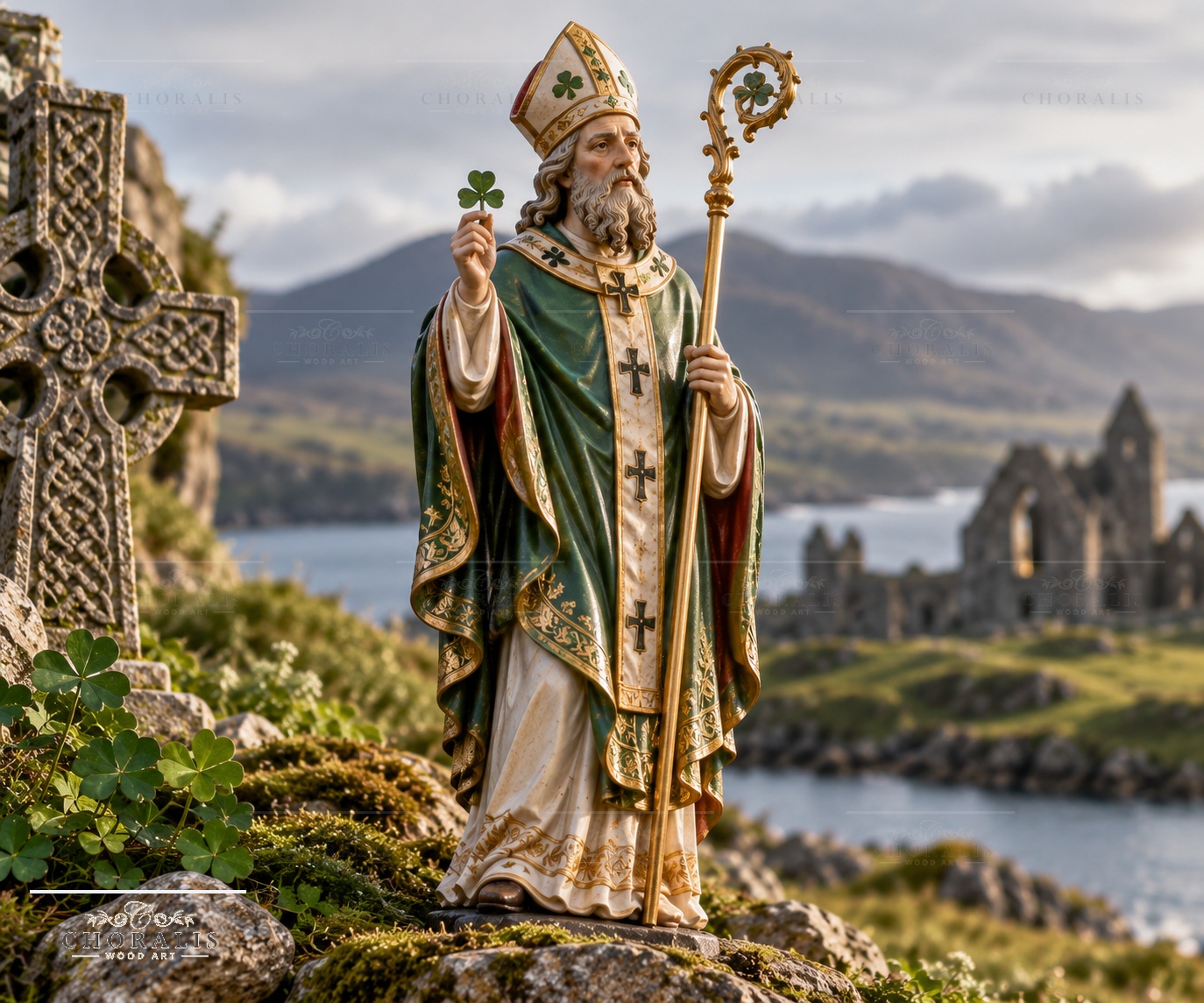
In Christian art, Saint Patrick is most often depicted as a bishop. His iconography combines symbols of episcopal ministry with traditional Irish attributes that developed around his missionary legacy.
Bishop's Mitre and Vestments
The mitre and episcopal vestments identify Patrick as a bishop and shepherd of the Church. They symbolize his responsibility for teaching, guiding, and caring for the Christian communities entrusted to him.
Pastoral Staff
The pastoral staff, or crozier, is another common attribute of Saint Patrick. It represents episcopal authority, but also the image of a shepherd who leads and protects the faithful.
The Shamrock
The three-leaf shamrock is probably the best-known popular symbol associated with Saint Patrick. According to later tradition, Patrick used it to explain the mystery of the Holy Trinity: one God in three Persons - the Father, the Son, and the Holy Spirit.
This story is deeply rooted in popular devotion and Irish culture, although it is not securely documented in Patrick's own surviving writings. In religious art, however, the shamrock became a clear and recognizable symbol of his teaching and of Ireland itself.
Snakes
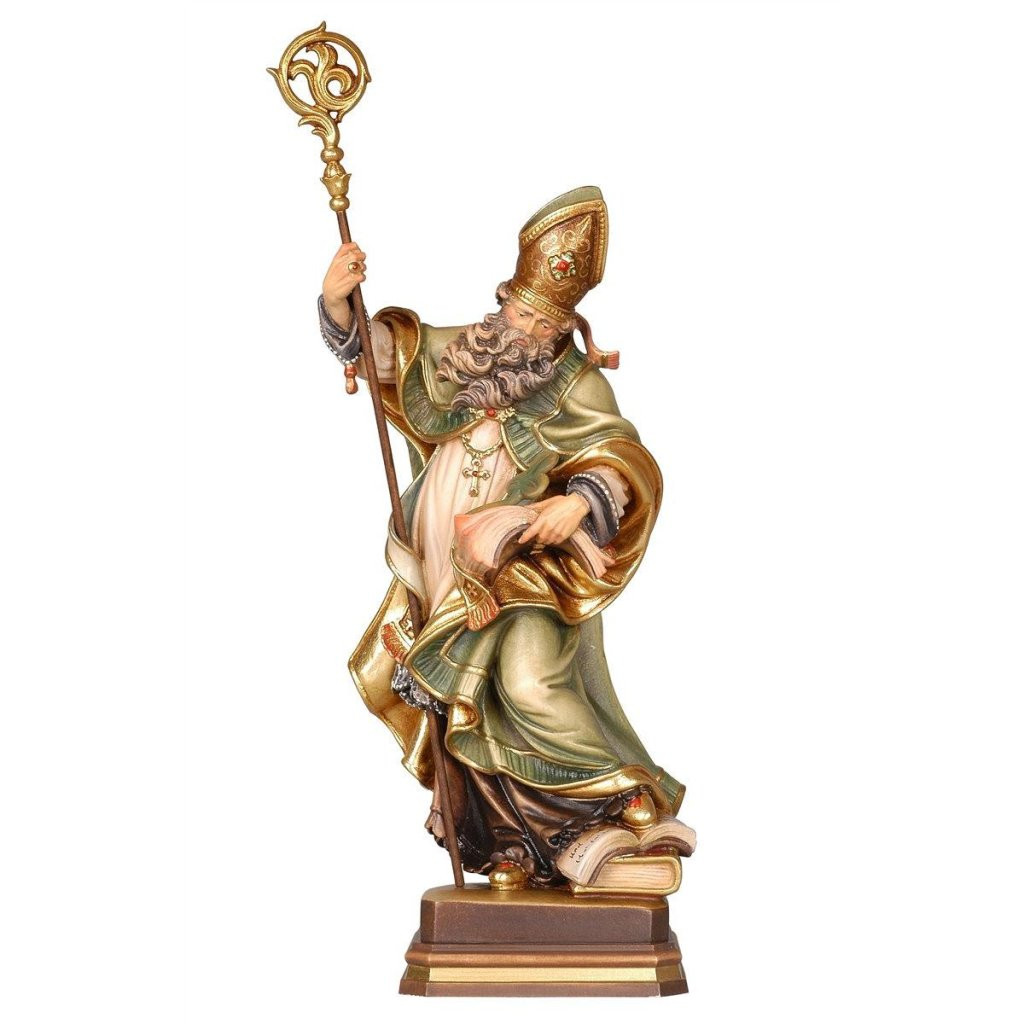
Saint Patrick is also traditionally associated with the story that he drove the snakes out of Ireland. This is generally understood as a legend rather than a historical event. In Christian symbolism, the snakes may represent evil, sin, or the overcoming of pagan beliefs through the spread of Christianity.
For this reason, some statues and paintings depict Saint Patrick with a snake beneath his feet or nearby.
Statue of Saint Patrick Bishop can buy here:
https://www.choralis.art/en/saint-men/st-patrick-1172662110
 Green Colour and Irish Landscape
Green, the shamrock, and the Irish landscape frequently appear in later representations of Saint Patrick. These elements emphasize his close connection with Ireland, even though Patrick himself was born in Britain.
Main Attributes and Symbolism
Statues, paintings, and icons of Saint Patrick most commonly include the following symbols:
- Bishop's mitre - a sign of his episcopal ministry and responsibility for the Church.
- Pastoral staff - a symbol of the bishop as shepherd and spiritual guide.
- Shamrock - a traditional symbol connected with the explanation of the Holy Trinity.
- Snakes - a legendary symbol of the defeat of evil and the spread of Christianity.
- Green vestments or Irish motifs - a reminder of Patrick's missionary work and his enduring connection with Ireland.
Saint Patrick and the Christianization of Ireland
Saint Patrick was not necessarily the first Christian missionary to reach Ireland, and Christianity had already begun to take root there before his mission. Nevertheless, he became the most famous figure associated with the country's Christianization.
His importance lies not only in the number of people he may have baptized or communities he helped establish, but also in the extraordinary nature of his return. Patrick went back to the land where he had once been enslaved and dedicated his life to serving its people.
His writings reveal a missionary who faced danger, opposition, uncertainty, and personal weakness, yet remained convinced that his work had meaning because it was entrusted to him by God.
This makes Saint Patrick's story more than a national legend. It is a story of forgiveness, vocation, courage, and the transformation of suffering into service.
Saint Patrick as Patron Saint
Saint Patrick is the principal patron saint of Ireland and is especially associated with the Irish people and Irish Christian tradition. His feast on 17 March became one of the world's best-known celebrations connected with a Christian saint.
He is also invoked by missionaries and by those who seek courage in proclaiming and living their faith. His life can speak especially strongly to people who find themselves far from home, who have experienced hardship, or who are beginning a new stage of life after a difficult period.
Patrick's example reminds Christians that painful experiences do not necessarily have the final word. The place of his captivity later became the place of his mission.
The Legacy of Saint Patrick
Saint Patrick remains a powerful symbol of missionary faith, courage, and perseverance. His story shows how a person can return to the place of former suffering not with revenge, but with a desire to serve.
In religious art, he is usually depicted as a bishop with a mitre and pastoral staff, often holding a shamrock. Some representations also include snakes or elements of the Irish landscape.
Statues and images of Saint Patrick are especially suitable for churches, chapels, parish spaces, Irish communities, missionary institutions, and private prayer spaces. They can also serve as meaningful religious gifts for people named Patrick or for those with a special connection to Ireland.
Behind the green colour, shamrocks, and popular celebrations stands a much deeper Christian message: faith strengthened through suffering, courage to follow God's call, and willingness to bring hope to others.
Prayer to Saint Patrick
Saint Patrick, faithful bishop and missionary, you found God in the loneliness and hardship of captivity and later returned with courage to proclaim the Gospel. Ask for us a steadfast faith, a humble heart, and the strength to follow God's call even when the path is difficult. Help us to forgive, to overcome fear, and to use our gifts in the service of others. Intercede for missionaries, for the people of Ireland, for those who live far from home, and for all who seek hope and a new beginning. Amen.