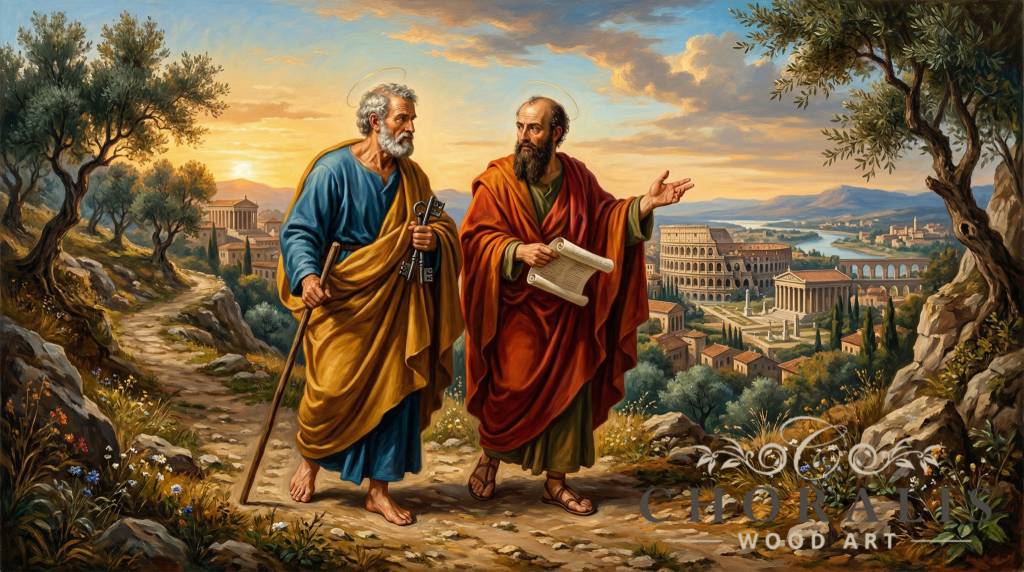
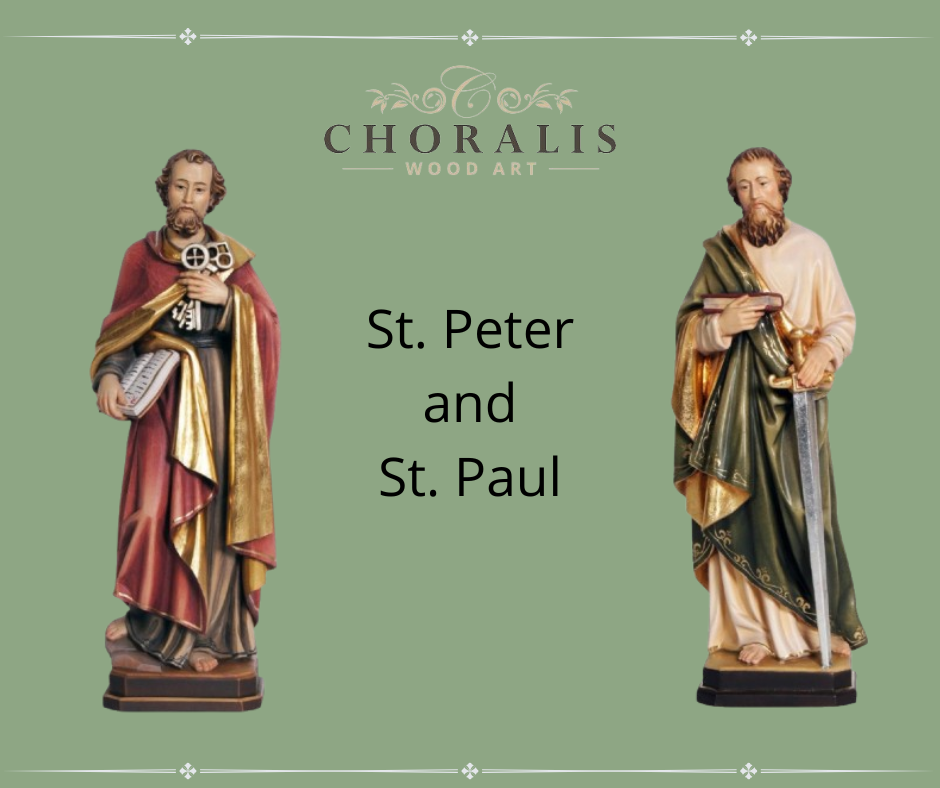
Peter and Paul are the foundational architects of Christianity, often referred to as the "Princes of the Apostles." While their backgrounds and temperaments differed—Peter the fisherman and Paul the scholar—their combined legacy shaped the early Church. In sacred art, they are frequently depicted together as the twin pillars supporting the house of faith.
The Dual Iconography of the Apostles
In the canon of Western art, from early Christian mosaics to High Renaissance frescoes, Peter and Paul are easily identified by their distinct attributes and physical characteristics:
• Saint Peter (The Rock): Usually depicted as an older man with silver, curly hair and a short beard.
◦ The Keys: His primary attribute, representing the "Keys to the Kingdom of Heaven" (Matthew 16:19).
◦ The Rooster: A symbol of his three-fold denial and subsequent repentance.
◦ The Inverted Cross: Marking his martyrdom in Rome, where he requested to be crucified upside down.
• Saint Paul (The Apostle to the Gentiles): Often shown as a balding man with a long, dark beard and a high forehead, suggesting intellect.
◦ The Sword: Symbolizing both the "Sword of the Spirit" (the Word of God) and the instrument of his decapitation.
◦ The Book or Epistles: Representing his prolific writings and theological contributions to the New Testament.
The "Concordia Apostolorum"
One of the most powerful motifs in art history is the Concordia Apostolorum—the embrace of Peter and Paul. This image symbolizes the unity of the Church, reconciling the mission to the Jews (Peter) with the mission to the Gentiles (Paul). It serves as a visual testament to the idea that diverse perspectives can unite under a single divine purpose.
You can buy statues of Saint Peter and Saint Paul here > https://www.choralis.art/en/saint-men
Historical and Cultural Significance
The impact of Peter and Paul extends far beyond the walls of the Vatican. Their lives represent two different paths to faith:
- Peter: The journey of human frailty, failure, and ultimate restoration.
- Paul: The radical transformation of a persecutor into a tireless missionary.
Their martyrdoms in Rome under Emperor Nero established the city as the center of Western Christianity. Today, the Basilica of St. Peter and the Basilica of St. Paul Outside the Walls stand as architectural masterpieces and pilgrimage sites, continuing to draw millions who seek to walk in the footsteps of these two giants.